HomeBlogBlogHow to Arrange Dining Room Furniture for Everyday Use

How to Arrange Dining Room Furniture for Everyday Use

How to Arrange Dining Room Furniture for Everyday Use

How to Arrange Dining Room Furniture for Everyday Use

Nathan Brown · 6 min

How to Arrange Dining Room Furniture for Everyday Use

Start with the room, not the table

Before moving furniture, note the room’s dimensions and the locations of doors, windows, outlets, and openings to adjoining spaces. Open each door so you can see its swing. Then trace the routes you use to enter the room, serve a meal, and reach any nearby storage.

Consider what the room does most often. Everyday meals may call for easy movement around every seat. If you also use the table for homework or projects, you may need space for supplies and a clear way to put them away. Occasional guests matter, too, but you do not have to arrange every day around your fullest possible table.

Start by removing unrelated items from the floor and tabletop. You can judge the available space without turning the rearrangement into a full-room decluttering project.

Test the table with people in place

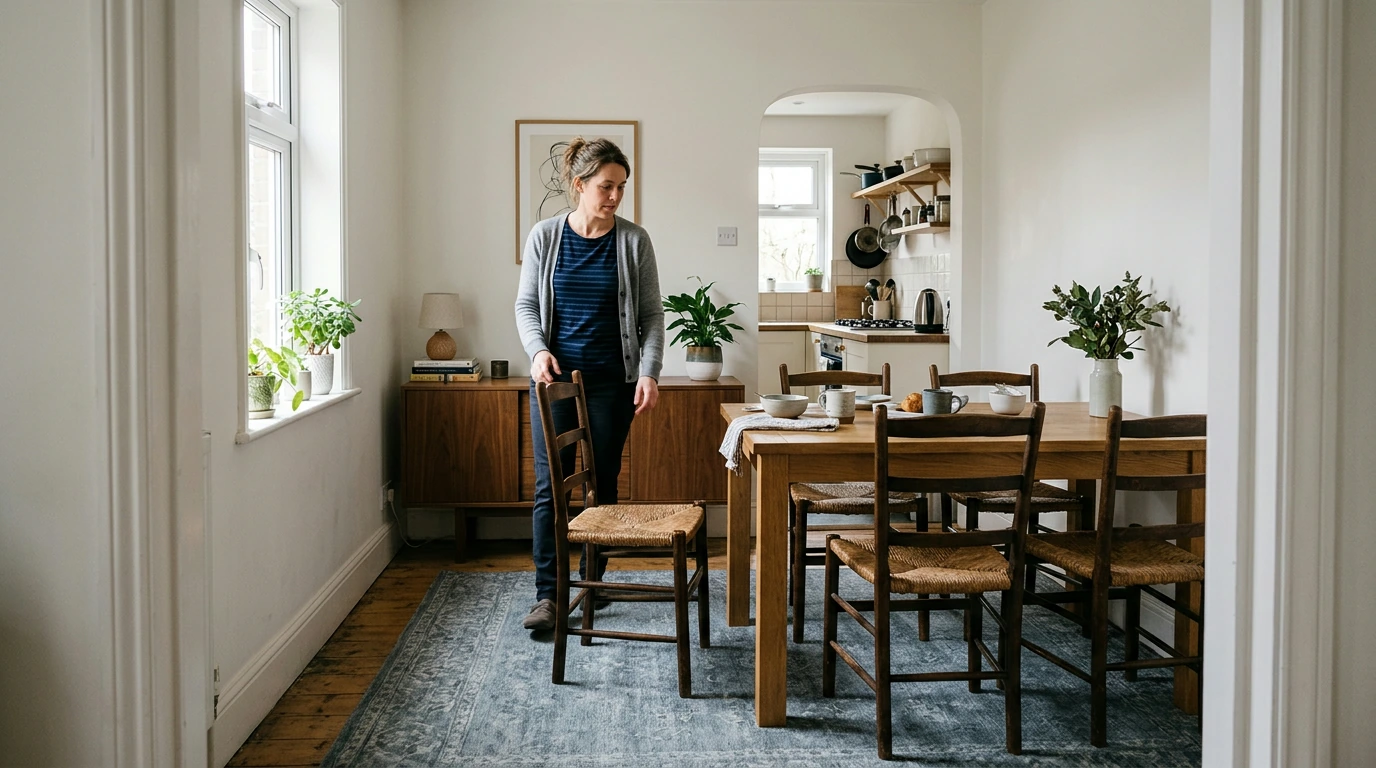
Set the table where you think it belongs, then pull out every chair, sit down, and walk behind occupied seats. Give priority to anyone who needs a wider, unobstructed route. If the kitchen-to-table path is tight, try shifting the table or keeping fewer chairs in the room before deciding you need new furniture.

A long, narrow room may suit a rectangular table placed lengthwise; a compact room may work better with a smaller or round table. Neither choice replaces the chair test. Doors still need to swing freely, and people should be able to enter without squeezing past a seated diner.

Featured in this guide

The Smart Guide to Arranging Your Dining Room | Digital Home Styling eBook for How to Arrange Dining Room Furniture | Modern Layout & Design Tips

View product

Let the focal point follow the flow

A window or light fixture can help you position the table, but perfect symmetry is less useful than a comfortable route through the room. If centering the table blocks a doorway or puts passing traffic close behind a chair, move it slightly and test again.

Add a sideboard only where you can open it while people are seated. If you use a rug, pull chairs out to see whether their legs remain on a stable surface during a meal. Keep tabletop pieces easy to move when it is time to eat or use the table for another task.

Use the eBook after the practical test

Once your table position and walking routes work, our The Smart Guide to Arranging Your Dining Room can help you explore modern layout and design ideas. It is a digital home-styling eBook, not a substitute for measuring your room or testing your chairs.

If household notes tend to collect on your dining table, our Expiry and PAO Tracker is an option for keeping product-expiration information together and the dining surface easier to clear.

Make one change, then live with it

You do not have to decide whether to buy a new table after a single walk around the room. Try one arrangement for several meals and notice where people naturally pause, turn, or ask someone else to move. Small adjustments can solve problems that first seem to require new furniture.

Our team suggests a straightforward order: clear the floor, place the table, test every chair, and walk your usual routes. Add storage and finishing touches only after the main layout works. If one person needs a clearer path, let that need guide the final position—even when a slightly off-center table is the result. The arrangement should fit the people who use the room, not just its dimensions.

Bring the layout together with a styling guide

Once you know which placement works, design choices become easier to make. Our The Smart Guide to Arranging Your Dining Room is a digital home-styling eBook for exploring modern dining-room layout and design tips. Use it alongside your measurements and the chair-and-walking tests, not in place of them.

If your dining table also serves as a spot for household planning, keeping those materials together can make it easier to clear the surface before a meal. Our Expiry and PAO Tracker is one option for organizing product-expiration information away from scattered notes on the table.

FAQ

What is the word for organizing your thoughts?

“Structuring” is one word for organizing your thoughts. For your dining room, writing down its regular uses can help you turn ideas into a workable plan.

What is the 1/3/5 decluttering rule?

The term can refer to different decluttering methods, so there is no single rule you need to follow. For this project, clear enough unrelated items to test how the room functions.

See if The Smart Guide to Arranging Your Dining Room | Digital Home Styling eBook for How to Arrange Dining Room Furniture | Modern Layout & Design Tips fits your setup

View product

Was this article helpful?

Yes No
Leave a comment
Top

Shopping cart

×